
Flint, MI · Garage Door Service
Is Your Old Flint Garage Door Worth Fixing or Should It Go
A look at when a 1960s-70s Flint garage door is worth repairing versus replacing, based on local housing age, climate, and parts availability in this service area.
- Repairs & new doors
- Springs & openers
- Serving 7 nearby communities
The Cost of This Job
We're not going to hand you a flat number here, because we don't have one to give you honestly - every one of these jobs depends on what's actually wrong and what parts the door needs. What we can tell you is how to think about it. Most of the housing stock in Flint went up between 1949 and 1993, with the median build year landing around 1970, which means a lot of the original garage doors and openers are pushing fifty years past their design life. On a door that old, the question isn't "what does a spring cost" - it's whether the track, hinges, and panel seams are even worth putting a new spring on. A torsion spring swap on sound hardware is a different job than one where the drum is pitted, the track is bent from decades of use, and the panel itself is rusting from the bottom up. We'll tell you straight if what you're looking at is a repair or if you're throwing good money after a door that's done. That's not us trying to sell you a new door - sometimes the honest answer is the repair, and sometimes it's not, and we'd rather say so before we start than after.
How Local Conditions Play In
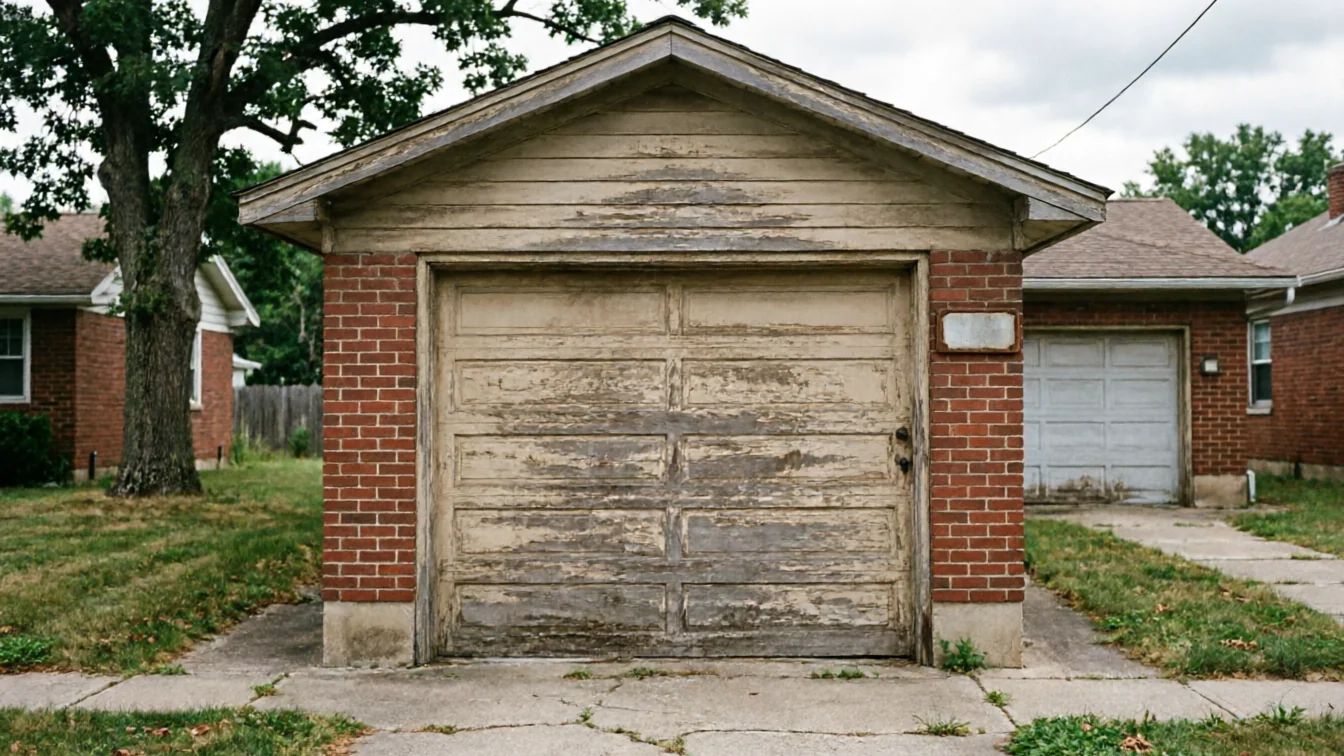
Across the 28 named areas we cover, the bulk of the housing is still 1960s and 70s construction, and that era of door and opener wasn't built with today's hardware in mind. A lot of these garages have steel doors on galvanized track that's held up fine structurally but was never insulated, never sealed against the kind of cold this region gets. Flint sits in a cold-severe climate band, so a door with a cracked panel seam or dried-out weatherstrip isn't just an eyesore - it's a path for ice and wind to work on a track that was never built for this many freeze-thaw cycles. On a door this age, we're often not just replacing a part, we're working around hardware that's been retrofitted once or twice already by whoever owned the house before. That changes what's worth fixing. A good spring and a clean track on an otherwise solid 1970s door is money well spent. The same spring on a door whose frame has racked out of square from forty winters of expansion and contraction is a patch, not a fix.
Season by Season
Cold-severe conditions mean the stress on an old door isn't steady - it spikes. In the deep of winter, steel contracts, lubricant thickens, and a spring that was marginal in October can snap on a January morning when you need to get to work. That's usually the call we get on an older door: not a slow decline, but a sudden failure on the coldest week of the year. Summer swings the other way - humidity and heat expand wood jambs and steel frames that just spent months contracted tight, and that's when we see tracks pull loose from brackets that have been slowly working free for years. A door built around the 1970 median age in this area has been through fifty-plus of these cycles already. If the hardware has held up this long without major repair, that's actually a point in favor of fixing it rather than replacing it - it's proven itself against conditions a newer, cheaper door hasn't been tested on yet.
The Situation
With 34,169 owner-occupied houses across the service area and a median household income of $62,678, most homeowners here aren't making this call lightly in either direction - not rushing to replace a working door, not limping along on a dangerous spring to save money. We work Burton four miles out, Beecher at five, Mount Morris and Grand Blanc further still, and the torsion springs failing on 1970s-era doors in those towns are usually the same age and the same builder-grade hardware we see closer to Flint itself. If your door is original to a house built in that 1949-1993 window, the honest first question is whether the frame and track are still square and the panels are still solid. If they are, a spring or opener repair is almost always the right call. If the door's been fighting itself for years - binding, sagging, patched more than once - we'll say so, and we'll tell you why replacement is the better money.
Frequently asked questions
How do I know if my old garage door is worth repairing?
Check the track and frame first - if they're still square and the panels aren't rusting through, a spring or opener repair on an older door is usually worth it. If the door binds, sags, or has been patched more than once already, you're likely looking at diminishing returns on repair money.
Why did my spring break in the middle of winter?
Cold contracts the steel and thickens lubricant, which puts more stress on a spring that was already marginal. In this climate, a spring that's been weakening for months often fails on one of the coldest days of the year rather than gradually.
My house was built in the 1960s or 70s - is the original door still safe to use?
A lot of doors from that era are still structurally sound if the frame hasn't racked and the hardware's been maintained. The risk is usually in the spring and track, not the panel itself. Worth having it looked at rather than assuming age alone is the problem.
Related garage door services in Flint
More garage door guides
Book garage door service in Flint
Call now or request a quote - tell us what the door is doing and where you are.